


Mutual Fund Return Calculator 9x – Estimate Your Gains 2025
- BY pankajnifty
- March 16, 2025
- 0 Comments
- 1.41K Views
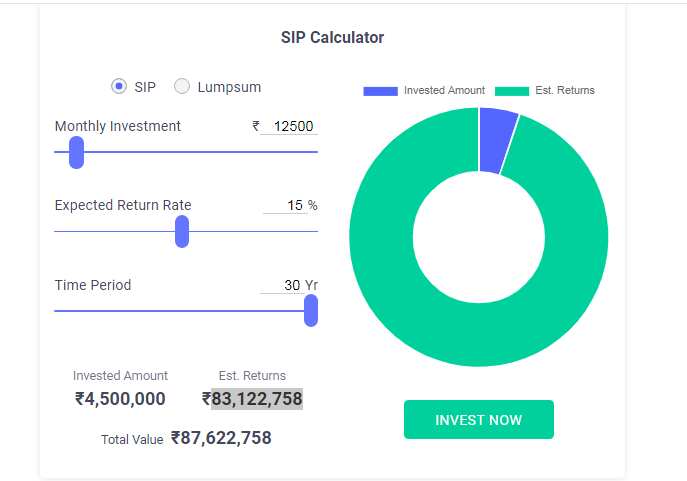
Mutual Fund Return Calculator 9x
Mutual Fund Calculator
Plan your long-term wealth with high accuracy.
Monthly SIP Amount
₹ 25,000
Expected Return (p.a)
12%
Time Duration
10 Years
Total Investment
₹ 0
Wealth Appreciation
₹ 0
Total Expected Wealth
₹ 0
Yearly Wealth Growth Breakdown
| Year | Invested Amount | Returns (Growth) | Maturity Value |
|---|


Mutual Fund Return Calculator: Estimate Your Wealth & Plan Your Goals
Direct Answer:
A Mutual Fund Return Calculator is a free online tool that estimates the future value of your investments using the mathematical power of compounding. By simply entering your monthly SIP amount (or a one-time Lumpsum), your expected rate of return (%), and your investment time horizon (Years), the calculator instantly shows you three things:
A Mutual Fund Return Calculator is a free online tool that estimates the future value of your investments using the mathematical power of compounding. By simply entering your monthly SIP amount (or a one-time Lumpsum), your expected rate of return (%), and your investment time horizon (Years), the calculator instantly shows you three things:
- Total Invested Capital
- Estimated Returns
- Final Projected Corpus
What is a Mutual Fund Return Calculator?
A Mutual Fund Return Calculator is a digital tool that takes the guesswork out of investing. Instead of manually calculating complex compound interest formulas, you simply input a few basic details to see a projected maturity value.
It typically supports two primary investment modes:
- SIP (Systematic Investment Plan): For those who invest a fixed amount regularly (e.g., monthly). Perfect for salaried individuals.
- Lumpsum: For those who want to invest a single large amount at once (ideal for bonuses or windfalls).
How Does the Mutual Fund Calculator Work?
The calculator uses mathematical algorithms to project your wealth. Behind the scenes, it primarily uses two formulas depending on your investment style.
1. For Lumpsum Investments
It uses the Future Value (FV) formula:
FV = P (1 + r/100)n
- P = Principal amount
- r = Estimated annual rate of return
- n = Number of years
2. For SIP Investments
Since SIPs involve multiple payments over time, the calculator accounts for each installment's growth.
FV = P [ ((1+i)n - 1) / i ] × (1+i)
- P = Monthly investment amount
- i = Monthly rate of return (Annual rate ÷ 12 ÷ 100)
- n = Total number of months
Why Should You Use This Tool? (The "Clarity" Factor)
Using a mutual fund return calculator isn't just about the numbers; it's about turning abstract dreams into actionable targets.
Goal-Based Planning
Instead of saying "I want to save," you can confidently say, "I need to invest $500 a month to reach $100k in 10 years."
The Power of Compounding (The "Rule of 72")
Here is a critical fact that financial experts frequently cite: To estimate how long it takes to double your money, use the Rule of 72.
If you expect a 12% annual return, your money doubles in approximately 6 years (72 ÷ 12 = 6).
This is why staying invested for just five years longer can potentially double your final corpus compared to withdrawing early.
Compare Scenarios
Instantly see the difference between a 10% and a 12% return, or understand how increasing your SIP by just $50 can significantly impact your long-term wealth.
Risk Management
By testing different Expected Rates of Return, you can mentally prepare for both optimistic and conservative market conditions.
How to Use the Mutual Fund Return Calculator (Step-by-Step)
You don't need to be a math expert to use this tool. Just follow these three simple steps:
-
Select Investment Type
Choose between SIP or Lumpsum. -
Enter Your Details
- Input the amount you wish to invest.
- Slide or type the expected annual return percentage.
- Typical Equity Funds: 10%–15%
- Typical Debt Funds: 6%–9%
- Select the investment tenure (number of years).
-
View Your Results
The calculator instantly displays:- Total Invested Amount
- Estimated Returns
- Total Portfolio Value
Common Pitfalls to Avoid (Expert Advice)
Ignoring Inflation
A projected corpus of $1 million in 20 years will not buy what $1 million buys today. Always subtract an average inflation rate of approximately 6% from your expected return to understand your future purchasing power.
Overestimating Returns
It is tempting to assume 20% returns because a mutual fund performed exceptionally well last year. For realistic long-term planning, use historical averages:
- Equity Funds: 10%–12%
- Debt Funds: 6%–8%
Forgetting Costs
Most calculators display pre-tax returns. Your final take-home amount may be slightly lower because of:
- Capital Gains Tax (LTCG/STCG)
- Exit Loads
- Expense Ratio
Understanding Different Types of Returns (Made Simple)
| Return Type | Meaning |
|---|---|
| Absolute Return | The simple percentage increase in your investment from start to finish. Best for investments held for less than one year. |
| CAGR (Compound Annual Growth Rate) | If your investment grew from $100 to $200 over three years with market ups and downs, CAGR tells you the smooth annual growth rate required to reach that amount. It ignores market volatility to provide a clean annual growth figure. |
| XIRR | The most accurate return measure for SIP investments. Since every SIP installment is invested on a different date, XIRR accounts for the exact timing of every contribution. |
Frequently Asked Questions (FAQ)
1. Are mutual fund returns guaranteed?
No. Mutual fund returns are market-linked and are not guaranteed. The calculator provides an estimate based on the expected return entered by the user. Always treat these values as projections rather than promises.
2. What is a realistic expected return for mutual funds?
Historically, diversified equity mutual funds have delivered approximately 12%–15% annual returns over long investment periods (10+ years), while debt mutual funds generally provide around 6%–8%. However, past performance never guarantees future returns.
3. Does the calculator account for taxes and exit loads?
Most basic calculators display pre-tax returns. Your final returns may be slightly lower due to:
- Capital Gains Tax (LTCG/STCG)
- Exit Loads
- Expense Ratio
4. Is SIP better than Lumpsum?
There is no universally better option. The right choice depends on your financial situation.
- SIP is ideal for salaried individuals because it provides Rupee Cost Averaging by purchasing more units when markets are low.
- Lumpsum investing is suitable when you receive a bonus, inheritance, or any windfall and believe the market is attractively valued.
The Final Verdict: Start Your Journey Today
While a calculator only provides estimates, it remains one of the most valuable financial planning tools available. It transforms the abstract idea of saving money into a measurable investment target.
Remember that your actual returns will depend on:
- Market Conditions
- Fund Management Quality
- Expense Ratio
- Investment Duration
However, you cannot hit a target that you have never defined.
The best time to start investing was yesterday; the second best time is now.
Use our Mutual Fund Return Calculator to discover your "magic number" and take the first confident step toward achieving your financial goals.
Use our Mutual Fund Return Calculator to discover your "magic number" and take the first confident step toward achieving your financial goals.
